

The SNC awards new wildfire resilience and recreation grants; starts two new grant programs
The Sierra Nevada Conservancy (SNC), a California state agency focused on improving the environmental, economic, and social well-being of the Sierra-Cascade, approved nearly $1.5 million to new early action wildfire-resilience projects and just over $3 million to new projects to help boost recreation and tourism in the Sierra-Cascade. The Board also approved new guidelines for another Wildfire and Forest Resilience program and guidelines for a new Landscape Grant Program that will increase the pace and scale of forest health and community protection.
“Since the governor approved the early action wildfire resilience funds from the Climate Bond in April of last year our staff has worked diligently to get investments out to our regional partners for high priority projects that protect communities and the landscape from damaging wildfires,” said Angela Avery, executive officer of the SNC. “Due to the action of our Board, that vital work continues, as well as new upgrades and improvements to a variety of recreation and outdoor opportunities throughout the Sierra-Cascade.”
Critical forest health and wildfire resilience will not slowdown in SNC’s service area either, added Avery, with the Board approving guidelines for two new programs, including a new Landscape Grant Program, that “will hopefully match the pace and scale of recent large, damaging wildfires.”
More wildfire and forest resilience work
In the Wildfire and Forest Resilience Directed Grant Program, the Board approved two new projects that will reduce overly dense fuels in Nevada and Mariposa counties. In Nevada County, the city of Grass Valley was awarded $720,000 to treat approximately 240 acres of forested land in Wolf Creek, Boston Ravine, and other locations in the southernmost portion of the town. The Mariposa County Fire Safe Council will utilize $756,179 in awarded funds to reduce fuels on 192 acres in the southwest region of Mariposa County near the communities of Ahwahnee, Nipinnawasee, and Ponderosa Basin. Fuelbreak areas along Stumpfield Mountain Road that were treated back in 2019 will be retreated.
Recreation opportunities and improvements
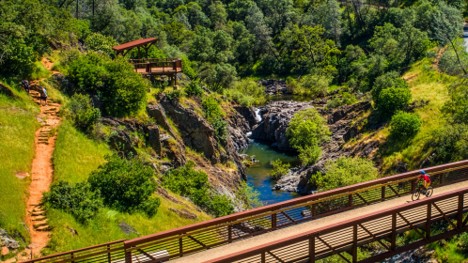
Seven projects in the Sustainable Recreation, Tourism, and Equitable Outdoor Access Directed Grant Program were approved for a total of $3,153,998 in funding by the Board that will help with planning and implementing of work to improve and restore trails and facilities in Butte, Kern, Mono, Nevada, Placer, Tehama, and Trinity counties.
In Kern County, the Yosemite Sequoia Resource Conservation & Development Council will use $479,263 to help plan the move of the Whiskey Flat Trailhead to land owned and managed by the U.S. Forest Service and complete environmental compliance for construction of a pedestrian bridge over Bull Run Creek near Kernville, Calif. Pending passage of this year’s state budget, another grant of $500,000 to the Kernville Chamber of Commerce will help complete environmental planning that will eventually lead to work that will turn a former Sequioa National Forest recreation site into a community park along the North Fork Kern River.

Two projects will begin recreation work in Placer County. The Placer County Division of Parks, Trails, and Open Space will utilize $500,000 to construct a new connectivity trail, which will provide a crucial link between the existing 1,200-acre Hidden Falls Regional Park and the Big Hill Preserve. The work will include construction of 3 miles of muti-use trail and three small bridges. Taking place in Placer and Nevada counties will be the Van Norden Meadow Recreation Project. With the help of a $499,950 grant, which is also pending passage of this year’s state budget, the South Yuba River Citizens League will build, improve, and formalize trail alignments to manage ongoing recreation use to protect sensitive meadow habitat and cultural resources.
In the north, in Trinity County, the Watershed Research and Training Center will use $499,785 to identify, evaluate, and make recommendations for priority recreation improvement needs in the approximately 300,000-acre landscape in the Trinity Alps Wilderness and Trinity Lake area. The Butte County Resource Conservation was awarded $500,000 to build a 4.3-mile trail and create new trailhead infrastructure as part of the Colby Mountain network of trails in the Lassen National Forest in Butte and Tehama counties.
Finally, Mammoth Lakes Recreation will utilize $175,000 to deploy three mobile, trailer-mounted watercraft decontamination stations to prevent and safeguard the pristine waters of Mono County from the threat of the invasive and destructive golden mussel.
The SNC only had roughly $4 million remaining in its Proposition 68 funding allotment for its Sustainable Recreation, Tourism, and Equitable Outdoor Access program. The SNC received $20 million in requests for viable, quality projects, however, illustrating the need to boost recreation, tourism, and outdoor access in the Sierra-Cascade.
New landscape and wildfire resilience programs
With an increase in high-severity wildfires throughout the Sierra-Cascade, the need to increase the pace and scale of forest-health and community-protection work is critical. The SNC Board approved Landscape Grant Program guidelines, which will fund landscape and forest collaboratives with shovel-ready projects that are part of a portfolio of restoration and resilience. Staff of the SNC will begin an internal evaluation process of ready landscapes, collaboratives, and projects and will bring grant award recommendations to the Board at its December meeting, at the earliest.
The Board also approved new guidelines for the next Wildfire and Forest Resilience Directed Grant Program that will focus on high-impact forest-health projects that deliver strong, direct benefits to communities, infrastructure, or unique natural resources.
More information about the two new grant programs will be published on SNC’s website.
Next fiscal year Action Plan approved
The SNC’s Strategic Plan identifies specific activities that the organization will focus on over a five-year period. The current 2024-2029 Strategic Plan includes implementing and advancing the regional goals of Healthy Forests and Watersheds; Resilient Sierra-Cascade Communities; Sustainable Recreation, Tourism, and Equitable Outdoor Access; and Conservation and Stewardship of Natural and Working Lands.
To help the SNC stay in alignment with its Strategic Plan, it also develops an annual Action Plan that identifies specific activities and focus areas for each year. At the meeting, the Board approved the 2026-2027 Action Plan.
Legal Disclaimer:
EIN Presswire provides this news content "as is" without warranty of any kind. We do not accept any responsibility or liability for the accuracy, content, images, videos, licenses, completeness, legality, or reliability of the information contained in this article. If you have any complaints or copyright issues related to this article, kindly contact the author above.
